Thursday, July 12, 2012
2012: Teamwork Takes Time
The girls need to be encouraged to work in small groups. On certain days, the girls I divided into groups of four to partner read a book and then discuss the theme, setting, etc. Teamwork was discussed and practiced beforehand. We need to, "Be positive, encouraging, and patient." Dr. Suess, a popular author among the girls this year, was chosen for our first group reading session. His books are engaging and enjoyable to kids of all ages. See above for photos and a video of the girls working together on their reading skills.
Dr. Suess is loved world wide!
Returning to Nicaragua for the fourth summer felt like
returning home. It was easy to get back into the swing of things. My first
Nicaraguan moment brought me to tears – all four family members (Leonela’s new
son Josue included) waved at me frantically though the enormous, glass window
that divides the baggage claim from the waiting area. After passing through
customs, my homestay family welcomed me with hugs and tears, as they now
consider me part of the family, and Doña Ivania considers me her “eight child.”
“Eres mi hija Americana….o hija adoptiva! Tienes piel más blanco, pero eres mia!”
Doña Ivania, my homestay mother gushed, as she and my brother and sister
enveloped me in a large group hug. Translated it means, “You are my American
daughter…or adopted daughter. Your skin is lighter but you are mine!” I
couldn’t feel more at home with them – and I am a tía (aunt)! Josue is 6 weeks
old and couldn’t be cuter. It feels so easy to live day in and day out with
them. I feel lucky to have a home away from home.
The reading workshops have been under way and the girls are
enjoying literature class. Gabi, another Haverford volunteer, has been a great
partner teacher. Upon arrival, the girls immediately started to ask me,
“Margarita, are we going to do reading class like we always do? Can we start
right now?” It is great to see them so
invested in the love of reading. We started each day with a read aloud during
lunch. The girls have been banned from talking during meals, so I deemed it
appropriate to pick out engaging books to read them during this time.
After eating, we then proceeded to the library and got to work. We would read another story as a group, discuss the meaning or moral of the story, as well as the characters and the setting. Among the girls’ favorite books were Oh the Places You’ll Go, Green Eggs and Ham, and The Lorax by Dr. Suess. Somehow, Dr. Suesss managed to rhyme many of his phrases in Spanish as well as English. Clever man or whoever translated his books! After reading a read-a-loud each day, Gabi and I then helped each girl pick out appropriate books for their reading levels. The girls easily fell into chairs and immersed themselves into their books. Every day I have been pleased to see the girls so focued. Reading is such a great escape from the everyday world.
Tuesday, June 19, 2012
Animal Rescue

Lulu, the Yahoskas dog, recently had a litter of seven puppies (Lulu is the white dog in the second picture). Five of them died from starvation. Upon my first visit to the Yahoska's home, I discovered the last two puppies (only six weeks old) being rejected by their mother. She bit them each time they tried to nurse, since she too is starving. Unable to focus on my projects intended for that day, because of the brown puppy that was dying on the ground, I decided my first project would be to save the pups. "Girls, the pups are going to die, like the other five, unless I take them to the vet." The girls helped me find an old box with which to carry the puppies. They emptied the soap and supplies that were being kept inside, and placed the dying puppy and its more lively sibling inside. Off I went with the other volunteer, Gabi, on a paseo to San Marcos.
In 2008, I had a similar experience with puppies, but had to transport them on over five hours of buses (see earliest blog posts). The 1 km walk and moto ride into town proved to be much easier than my previous trip with puppies in a box! We visited the nearest veterinarian. My granny always tells me to keep a $50 bill hidden in my wallet for emergencies. The last time I had used it was for the last batch of puppies, so I thought it appropriate to try the same approach. Most Nicaraguan veterinary offices do not take animals overnight, but with the offer of $50, they made an exception. They agreed to recuperate the starving pups, give them all necessary vaccines, and feed them every two hours for seven days - all for the price of $50. Small amounts of money and effort go a long way in Nicaragua.
The next challenge was to find a good home for these tiny animals, whom should be with their mother for another six weeks or so (but this would not be possible, as their original home does not have the means to feed them and give them the proper care).
I returned to the Yahoskas for the rest of the day, and decided to visit the vets office after work to check in. AMAZING! One of the men who works at the office took a liking to the babies, and asked if he could have them. Who better to take the dogs than a person from a veterinary office? Successful first Monday in Nicaragua!
Location:San Marcos, Nicaragua
Thursday, June 14, 2012
2012: Richmond 4th Graders Engage in Philanthropy Project!
My students and I carried out our annual philanthropy unit, exploring the meaning of helping others and making a positive impact on our world. We carried out the Three Cups Of Tea young readers literature unit, learning about how many people in the world are deprived the right to education. After falling in love with the children of Korphe, Pakistan, as well as hearing my many stories of the street children in Nicaragua, my students were eager to help.
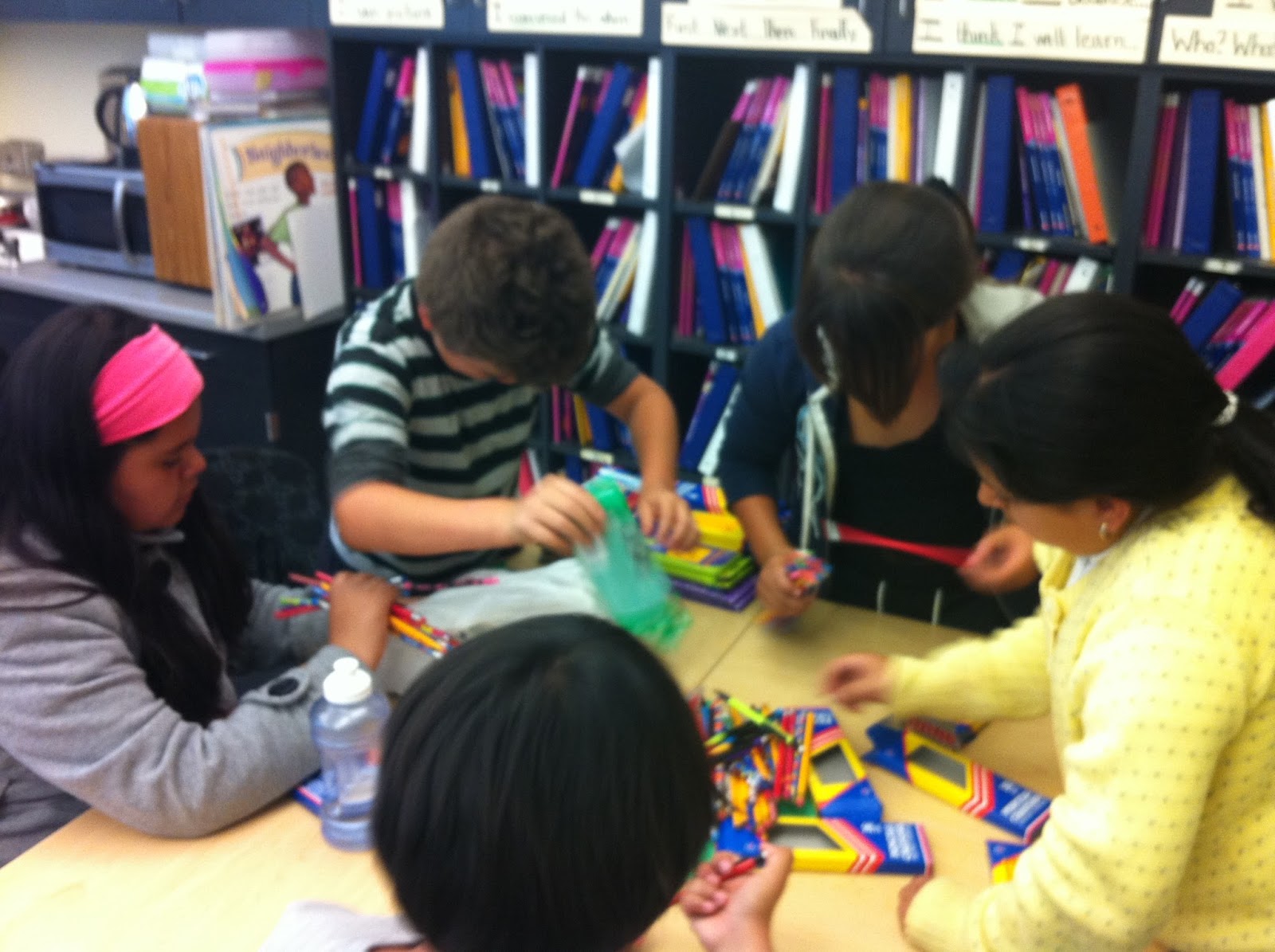
After six weeks, students fulfilled their goal to fill two, large suit cases of donations for the street children I work with in Nicaragua. They brought in Spanish books from home and bought out many dollar stores in order to bring in school supplies for the Yahoskas. This year's class, only 26 students, raised 96 pounds of Spanish children's books and school supplies. As you can see in the first picture, students sorted the donation boxes into categories, helping me to remove all the packaging in order to more efficiently save space in the suit case (being sure to recycle all paper and plastic products). In 2011, I didn't think to have my students engage in this process, and I ended up spending many hours doing it myself. You learn with each year! While they were sorting, many of them said, "Ms. Bishop, this feels so good!" It was motivating to see such young students thinking beyond themselves, giving to those who need help. One of them, who has been saving money for college, spent some of her own money to buy supplies. Her mother was really proud of her decision and contribution, as am I! In order to change the world, we have to change mindsets. There is always a way to help out!
Most importantly, students engaged in the writing process by composing thoughtful pen-pal letters to the Yahoskas. To make a child feel important via a letter can be very powerful. I remember feeling so special getting mail at camp from my mother and family, and I can't imagine what it would feel like to get a letter from a curious pen-pal from another country. Students were instructed to describe their community, family, interests,
and school life (along with whatever other details they could write full paragraphs about) in their letters. Students wrote in their languages of choice, after careful planning. When final drafts were complete, students who didn't know how to write in Spanish were tutored by students who could. Many hours were spent in translation stage, but after much work all the letters were successfully translated into Spanish! Andres, who volunteered for the day, was able to help one of my students learn some Spanish during the translation process (his mother has given consent to display this photo). Six of my previous students, currently on their way to the sixth grade, wrote second letters to their pen-pals from last year.
Richmond students, you are changing the world and helping out those in need! Thank you to parents and community members who helped to make this project a reality!
After six weeks, students fulfilled their goal to fill two, large suit cases of donations for the street children I work with in Nicaragua. They brought in Spanish books from home and bought out many dollar stores in order to bring in school supplies for the Yahoskas. This year's class, only 26 students, raised 96 pounds of Spanish children's books and school supplies. As you can see in the first picture, students sorted the donation boxes into categories, helping me to remove all the packaging in order to more efficiently save space in the suit case (being sure to recycle all paper and plastic products). In 2011, I didn't think to have my students engage in this process, and I ended up spending many hours doing it myself. You learn with each year! While they were sorting, many of them said, "Ms. Bishop, this feels so good!" It was motivating to see such young students thinking beyond themselves, giving to those who need help. One of them, who has been saving money for college, spent some of her own money to buy supplies. Her mother was really proud of her decision and contribution, as am I! In order to change the world, we have to change mindsets. There is always a way to help out!
Most importantly, students engaged in the writing process by composing thoughtful pen-pal letters to the Yahoskas. To make a child feel important via a letter can be very powerful. I remember feeling so special getting mail at camp from my mother and family, and I can't imagine what it would feel like to get a letter from a curious pen-pal from another country. Students were instructed to describe their community, family, interests, Richmond students, you are changing the world and helping out those in need! Thank you to parents and community members who helped to make this project a reality!
Friday, July 29, 2011
2011: Sustainability and Reflection
After three internships in Nicaragua, I thought it was time to share my experiences and feelings
about Los Quinchos with both the founder and director of the organization. I struggled to come up with a project that would help Los Quinchos hold their workers accountable for reading and working academically with the Yahoskas. Unfortunately, the girls are limited to a three hour school day. With ample amounts of free time, they need structured literacy instruction in order to gain the lost yards in their educations. With the library resources Nour and I have provided over the years, and the reading-workshop trainings we have modeled, they have the resources to increase academic rigor for these kids. The Quinchos have the main library, and a wonderful librarian, that is often unused.
I was frustrated to see that the books were not used on a daily basis. I shared this with Zelinda and Carlos Vidal in our hour and a half reflection/planning meeting. I proposed the development of a documentation system for the main Los Quinchos library, as well as the Yahoska library.
This system requires the educators to log their daily reading sessions with the children. Zelinda and Carlos really liked this idea, so I developed the spread sheets and had them bound into accountability books.
The educators (the employees who work at the Yahoska complex and the main Los Quinchos library) will need to document who is supervising reading time, the date, what time the library is opened, and what children are present at the time of reading workshop. This system will allow the director to know to what degree the academic resources are being utilized.
We also developed a concrete reading schedule for the girls - with an hour and a half of reading built into each day! Lets get reading!
I was frustrated to see that the books were not used on a daily basis. I shared this with Zelinda and Carlos Vidal in our hour and a half reflection/planning meeting. I proposed the development of a documentation system for the main Los Quinchos library, as well as the Yahoska library.
This system requires the educators to log their daily reading sessions with the children. Zelinda and Carlos really liked this idea, so I developed the spread sheets and had them bound into accountability books.
The educators (the employees who work at the Yahoska complex and the main Los Quinchos library) will need to document who is supervising reading time, the date, what time the library is opened, and what children are present at the time of reading workshop. This system will allow the director to know to what degree the academic resources are being utilized.2011: International Pen Pals
Letter writing is an essential fourth grade writing standard. Knowing this, I wanted my fourth grade students in Richmond, California to feel a sense of purpose when writing a letter to another person. With this notion, our class decided that we would write letters to the children I work with in Nicaragua. After much investment in our philanthropy unit, reading Three Cups of Tea, and gathering donations for Los Quinchos, my students were ecstatic when I allowed them to paint pictures of their lives via letters. Knowing that another child, in another part of the world, might enjoy what you have to say is an exciting idea! Half of the letters were in Spanish (as half of my students came out of the bilingual program and have the ability to write in Spanish) and half of my students wrote in English.
Each Yahoska received one or two letters, depending on their writing ability and age, to read and then respond to. The girls were stoked to receive letters from my students!
I can't wait to throw my previous 4th grade students in Richmond, who are now big fifth graders, a Nicaragua party so that they can see the pictures of the girls receiving the donations they collected, as well as receive their pen pal letters!
2011: Richmond, CA Elementary Students Help Those in Need!
As mentioned below, my fourth grade students got really into our 4th grade philanthropy unit (see several posts below). After lugging the suitcase of donations to Nicaragua, my homestay sister, Leonela, and I spent a few hours equally dividing the donations into 30 zip-lock bags. Without any convincing, she decided to come with me to the
We followed up reading workshop with the donation give-away. Before I handed out the bags, Leonela and I explained that the donations were from low-income, inner city students (the
Several were teary, several smiled and carefully stored their new supplies in their rooms, and a few didn't know what emotion to display. Others merely carried their bags around with them for the remainder of the day, displaying that the new supplies were very special to them.
Saturday, July 23, 2011
¿Vamos a leer?
What proved to be difficult was having deep discussions around theme. The first few times we read together, there were few hands raised when I asked, "What do we think the author is trying to teach us? What is the broad idea or message in the story (aka theme)?" even after defining and discussing what theme is and means. Initially,
It was exciting for the Yahoskas to realize that there can be many correct answers to the questions I was asking. All one needs is reasonable evidence to prove a point, and with textual backup, almost anything can be argued. I loved watching the smiles on the girls faces when I validated their responses. Having watched students in Richmond, California light up when being complimented and validated, even for repeated responses already given, I knew this aid me in drawing more of the Yahoskas into discussions. The teaching profession easily transcends countries' borders :)
I also want to thank my college professors and mentors - they never gave up on me and believed I could be a successful Haverford student despite my rural, public school background. Any student has the ability to achieve a high-quality education, and Haverford gave me a chance! These students in Nicaragua deserve these chances as well.
Sunday, July 17, 2011
Library Organization and Reading Workshops
Nour and I spent many hours reorganizing the previously purchased books into sections. Since we had no means in which to level the books according to grade level, we bunched the primary books on specific shelves and the secondary books on others, all with appropriate labels. The first go around, the books were categorized by genre, but this new system seems to be working better - the girls are learning to reference and visit the shelves that correspond more closely to their reading levels (see before and after photos above).
We taught them the rule of five, aka if there are more than five words that you do not know on one page, the book is probably too hard for you. It is time to put it back and find another book! Thanks to many of my great mentor teachers, this seems to be working.
Since then, I have spent every day doing a series of reading workshops. I start by doing a read-a-loud that has a strong message or vivid imagery. While reading the book, we stop and make predictions, check for comprehension, make connections to our own lives, and summarize what we have read.
Throughout the passing weeks, I am pleased to see that the girls are extremely eager to participate in reading workshop. I walk into their home and one of the first questions they ask is, "Margarita vamos a leer?!" This daily question has kept me smiling through the parasites and recent kidney infection.
Wednesday, July 6, 2011
2010: The love of reading is learned
After having settled into a concrete pattern, I am starting to feel the forgotten tug at my heartstrings as I read more and more with Las Yahoskas. I returned to Nicaragua to see the library I started in a state of disarray. The books were disorganized, all the puzzles Nour, another Haverford volunteer, had purchased were left in pieces, and the posters I had made were in a corner. Despite this, it is clear that the girls have been using the books, which is a start.
Reading books is the first step, but easy access to books that a child can comprehend is the next step. The library needed to be reorganized, cleaned, and revamped. The girls need to be taught how to organize and maintain the library without volunteers doing it for them. Having learned many things from my Teach for America experience, I have come to realize I did a poor job of teaching library procedures to the girls. Building this notion into my volunteer plans, I now realize that I gave the girls fish without teaching them how to catch the fish themselves. Over the past week, Nour and I have spent many hours organizing, planning, cleaning, and teaching. The fishing practice has begun. Details to come!
Location:San Marcos, Nicaragua
La Iglesia

I had my first Nicaraguan, Evangelical church experience last Tuesday. My homestay mom, Dona Ivania, asked me to accompany her, so I thought I would give it a shot. As we entered the open-air church, it started to downpour on the tin roof above, relaxing me, as I am very used to the comforting sound of the rain's pitter-patter. Accordingly, the small congregation began to sing a sweet song saying, "Let god rain down on us." The song continued for about an hour, and as time went on, I watched many people sway to the music while weeping. The singing provided a good outlet in which the community could release their emotions. In places that bear such hardships, church remains a place in which people can come together and release pent up feelings.
Location:San Marcos, Nicaragua
Tuesday, June 28, 2011
4th Grade Philanthropy Project
My year has been full of laughter, tears, and amazement as a Teach for America Corps Member. Teaching 4th grade at the lowest performing elementary school in Richmond, California has been an incredible learning experience. My 32 students were full of energy, excitement, and passion. As the year progressed, I started to share my Nicaraguan experiences in the classroom. My students' interest was instantly sparked and they continuously asked me questions about the Yahoskas and Los Quinchos.
Feeding off their energy, I planned and implemented a philanthropy unit, in which the students read Three Cups of Tea:
My students also wrote pen pal letters to the Yahoskas. While in Nicaragua, I will conduct a series of writing workshops in which I will help the Yahoskas learn how to write friendly letters in a three paragraph format. I think they will really enjoy connecting with my 4th graders, many of whom are from Mexico. In several of their letters, students describe their experiences as Latinos in the United States, as well as what life is like living in an impoverished, urban community.
Monday, June 27, 2011
2009 Projects
Before I depart for Nicaragua this year, I wanted to sum up the 2009 experience I had with a few photos and explanations, since I broke my fingers and directed readers to the Picasa photo site:


1) The Yahoska library was constructed, thanks to the many donors (you know who you are!). The girls now have access to books at their home. With the $2000 raised, I was able to buy several hundred books for the library.
To the right is Doña Ivania (the Los Quinchos librarian/my homestay mother) at Ispamer, the main book store in Managua. In the middle is a photo of Chris (a carpenter from the United States, was generous enough to make the bookshelf for free) and a few workers from Los Quinchos helping to set up the bookshelves needed for the project.
Below are photos of the girls helping me to organize the books into categories, labeling of the categories on the bookshelf, and the final product!
2) Together, the girls and I did a good bit of both individual and group reading. I was pleased to see their interest and enthusiasm for reading increase over the course of my stay.
2) With the Yahoska psychologist present, I organized and lead a two-part sexual education workshop with the oldest Yahoska girls. Each one lasted about two hours and the girls had the chance to discuss any topics they chose. For thirty minutes, the girls wrote down questions they had and passed them in anonymously. We then formed a circle and placed all the questions in the middle. The girls read them aloud and we had discussions about each question. The intention was to only do one session, but the girls requested a second.
3) Using the poetry of Ruben Dario, Garcia Lorca, and Pablo Neruda, I put together poetry
books for each of the girls. Using these compositions, we engaged in poetry workshops in which we learned about similes, metaphors, personification, and the use of vivid imagery. After various sessions, I passed out notebooks for the girls to write their own poetry and prose. After engaging in many writing workshops, the girls produced some fantastic work!
4) Using the poetry and prose the girls wrote over the duration of my stay in San Marcos, they performed their favorite pieces at the Quinchos first Open Mic Night. Italian volunteers, the directors of Los Quinchos, as well as many boys from the boys program attended the two-hour performance. The girls performed beautifully after our long dress-rehersal, in which we learned how to project our voices, speak with distinction, and stand proudly as we share.
Subscribe to:
Posts (Atom)